
What would change about your DeFi workflow if every on‑chain action came with a clear “what will happen” preview before you signed? For experienced DeFi users in the US—traders, LPs, yield farmers, and ops teams—the difference between blind signing and simulated signing is not merely convenience. It’s a risk management primitive that alters how you design trades, set approvals, and integrate hardware and multisig custody.
This article drills into the mechanisms behind transaction simulation, why it matters for multi‑chain operations, how Rabby implements these mechanisms within a broader security posture, and where this approach succeeds and still falls short. The goal is practical: give you a sharper mental model for deciding if a wallet with built‑in simulation should be part of a professional DeFi toolkit, and how to combine it with other controls.
How transaction simulation works — the mechanism beneath the UX
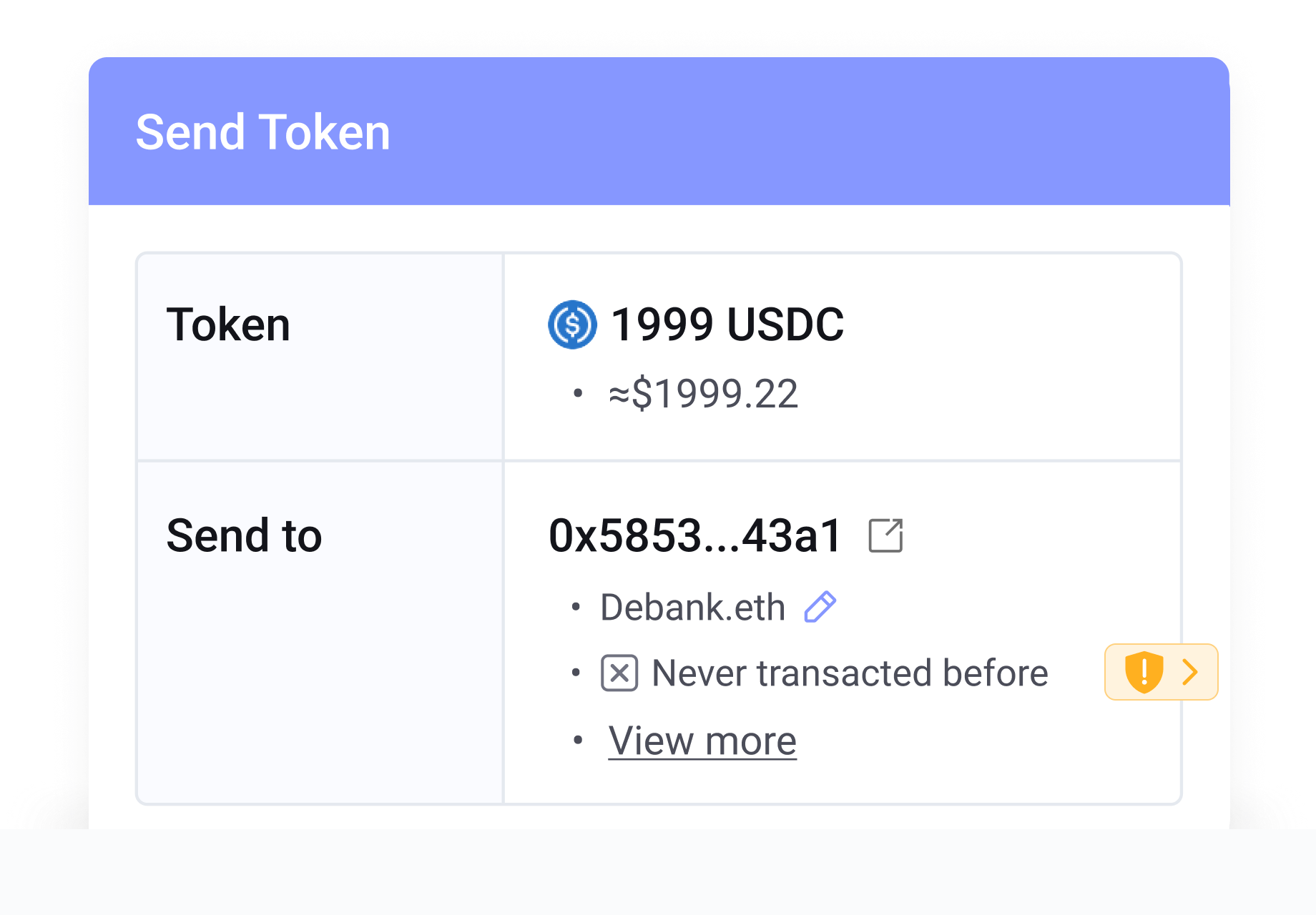
At its core, transaction simulation is a local or remote dry‑run of the exact EVM call(s) the user is about to sign. For an Ethereum‑compatible chain, simulation replays the intended transaction against a recent block state without broadcasting it. The wallet inspects the simulated effect: token balance changes, internal contract calls, gas consumed, and whether the transaction would revert. A well‑designed simulator also flags suspicious patterns—such as token approvals to unknown contracts, attempts to drain allowances, or calls to contracts recorded in breach databases.
Mechanically, there are three important components: 1) a faithful state snapshot (either a remote node or an indexed archive), 2) a sandboxed EVM execution environment that mirrors current chain semantics, and 3) a risk engine that translates low‑level effects into human‑readable alerts. Each component has trade‑offs. Remote node snapshots are convenient but create centralization and privacy leakage risks; local simulation is privacy‑preserving but requires more local resources or running a node; and the risk engine’s heuristics will always produce false positives and false negatives.
Rabby’s implementation: bundle of features and how they fit together
Rabby Wallet combines transaction simulation with several adjacent controls that together form a layered defense for multi‑chain DeFi use. Important elements from Rabby’s architecture include portfolio aggregation across 90+ EVM chains, pre‑transaction risk scanning, built‑in approval revocation, automatic network switching, and integration with hardware and institutional custody solutions. The wallet is open‑source under MIT, which increases transparency for security‑minded teams and auditors.
For a DeFi power user, those capabilities add operational value. Simulation prevents blind signing by showing precise balance deltas and estimated fee costs before confirmation; approval revocation helps limit persistent exposure when you must grant allowance to DEX routers or staking contracts; and automatic network switching reduces accidental interactions on the wrong chain—an easy way to lose funds when you’re juggling wallets and bridges. You can learn more about the basic download and platform options at rabby.
What this stack prevents — and what it does not
Transaction simulation meaningfully lowers several risks: authorizing malicious approvals, signing transactions that silently transfer unfamiliar tokens, and wasting gas on calls that will revert. When paired with hardware wallets and multi‑sig, simulation adds another verification layer: the user sees a readable summary and can cross‑check against the hardware device’s display or the multi‑sig policy before signing.
However, simulation is not a panacea. It cannot protect against bugs or malicious logic that only manifests under specific off‑chain conditions, oracle manipulation, or front‑running by MEV actors on re‑ordering or sandwich attacks. Simulation relies on a reasonably current chain state—if the node snapshot is stale, the simulation may miss race conditions. And because risk engines use heuristics, they may produce false negatives (novel attack vectors) or false positives (over‑blocking benign complex interactions).
Trade-offs for professional users: privacy, speed, and operational complexity
Choosing a wallet with simulation introduces three practical trade‑offs. First, privacy: simulation often requires querying nodes or services that learn about your intent. For an institutional trader, that telemetry could be sensitive. The countermeasure is to prefer wallets that support local simulation or run your own node. Rabby supports hardware integrations and is open‑source, which helps, but users should still consider the telemetry path when using hosted node providers.
Second, latency. Running full, reliable simulations can add a small delay to signing flows—acceptable for routine approvals but potentially costly for latency‑sensitive arbitrage. Power users may split workflows: use simulated signing for complex approvals and on‑chain state changes, and reserve low‑latency environments for time‑critical arbitrage where you accept additional operational risk controls.
Third, cognitive load. Rich simulation output forces more decisions—do you cancel this complex approval or use a reduced allowance? Over time, sensible defaults and approval‑revocation tooling reduce friction, but teams must design standard operating procedures (SOPs) to avoid decision fatigue leading to skipped checks.
Failure modes and lessons from past incidents
Rabby’s history includes a 2022 exploit of a related swap contract, which cost roughly $190,000 before mitigation actions were taken. The team froze the contract, compensated users, and increased audits. That episode illustrates an important point: wallet‑level defenses and smart‑contract audits are complementary, not substitutes. Wallet features can reduce certain user errors or bad approvals, but when a protocol contract itself is vulnerable, the wallet cannot eliminate systemic risk.
That incident also underlines the governance and remediation trade‑offs teams must accept: fast response (freezing contracts) helped limit losses, but not all projects will have the ability or willingness to compensate victims. Power users should therefore combine wallet protections with project diligence: check audit histories, monitor bug bounty activity, and limit per‑project exposure rather than relying solely on wallet-side defenses.
Practical framework: when to prioritize simulation in your stack
Here’s a simple heuristic to decide when wallet transaction simulation should be enforced in your workflow:
– High‑risk, low‑frequency actions: Always simulate (e.g., new approvals, multisig module changes, large withdrawals). The cost of delay is small versus potential loss.
– High‑frequency, low‑value operations: Use stricter monitoring and automated allowance patterns (tight expirations) but accept selective bypass for latency‑sensitive trades after manual or scriptable safeguards.
– Institutional operations: Combine simulation with multisig custody (Gnosis Safe) and enterprise integrations (Fireblocks, Amber) to create multi‑party checkpoints and separate transaction proposal from signing.
This framework balances safety and operational agility. It also makes clear the value of a wallet that supports both simulation and enterprise integrations: the wallet becomes a control plane, not just a signing tool.
What to watch next — signals that would change the calculus
Three developments would materially shift how valuable built‑in simulation is: 1) broader adoption of bundled local node providers, which would reduce privacy trade‑offs; 2) standardized, machine‑readable transaction descriptors adopted by major dApps to make simulation outputs more reliable and less opaque; and 3) better MEV mitigation layers that remove predictable re‑ordering attacks from common flows. If those happen, simulation will be more private, faster, and more decisive.
Conversely, if cross‑chain complexity continues to outpace tooling (e.g., novel bridging primitives that create complex inter‑chain state dependencies), simulation confined to a single chain may become less predictive and therefore less useful for cross‑chain operations. That risk is why wallets that support cross‑chain gas top‑up and multi‑chain asset aggregation—features Rabby provides—are operationally helpful but still imperfect.
FAQ
Does transaction simulation stop scams?
Simulation reduces exposure to many common user‑level scams—especially malicious approvals and blind transfers—by showing exact balance effects before signing. It doesn’t, however, prevent protocol‑level vulnerabilities, oracle manipulation, or attacks that rely on off‑chain data. Treat simulation as an important layer, not a solitary solution.
Can a wallet simulation be trusted if it uses remote nodes?
Remote nodes make simulation convenient but introduce privacy and potential state‑freshness issues. A trusted remote provider plus short staleness windows is workable for many users; institutions should prefer local nodes or private RPC endpoints to reduce telemetry leakage and minimize stale state risk.
How should I combine Rabby with hardware wallets and multisig?
Use Rabby’s simulation and risk alerts for transaction preview, but perform signing on a hardware device for private key security and route high‑value or policy‑sensitive transactions through a multisig flow (e.g., Gnosis Safe). This combination gives you the best of auditability, human review, and cryptographic protection.
Are there alternatives that offer the same protections?
Competitors like MetaMask, Trust Wallet, and Coinbase Wallet offer many core features but generally lack Rabby’s specific blend of pre‑transaction simulation and automatic network switching. Each wallet has different trade‑offs in UX, telemetry, and custody integrations; evaluate them against your operational priorities.
Takeaway: for DeFi power users in the US juggling multiple EVM chains, transaction simulation changes the decision boundary between speed and safety. It doesn’t eliminate systemic protocol risk, but when combined with hardware keys, multisig, approval revocation, and sensible exposure limits, it materially reduces the most common user‑level causes of loss. If you manage sizeable on‑chain positions, treat simulation‑capable wallets as a control you should demand, not an optional convenience.