
Imagine this: you’re at your desk, newsfeeds flashing that OKX just delisted a handful of small spot pairs this week, and you need to move capital quickly between spot and margin accounts to protect a position. You open the exchange, your browser asks for a passphrase, your phone buzzes with a biometric prompt, and a pop-up warns you to verify the domain. Which signals do you trust? What are the real failure modes between a secure login and a disastrous delay? This article walks through a concrete login-and-trade scenario to teach mechanisms, clarify trade-offs, and give U.S.-based traders decision-useful rules of thumb.
We’ll treat a single user story as a laboratory: a U.S. retail trader with accounts on OKX who needs to log in from a laptop, access the non-custodial Web3 wallet via a browser extension, and execute a margin adjustment on the exchange. Along the way I’ll show how OKX’s account protections, cross-platform tools, and product mix change the set of practical risks and choices, and where the system can still fail you.
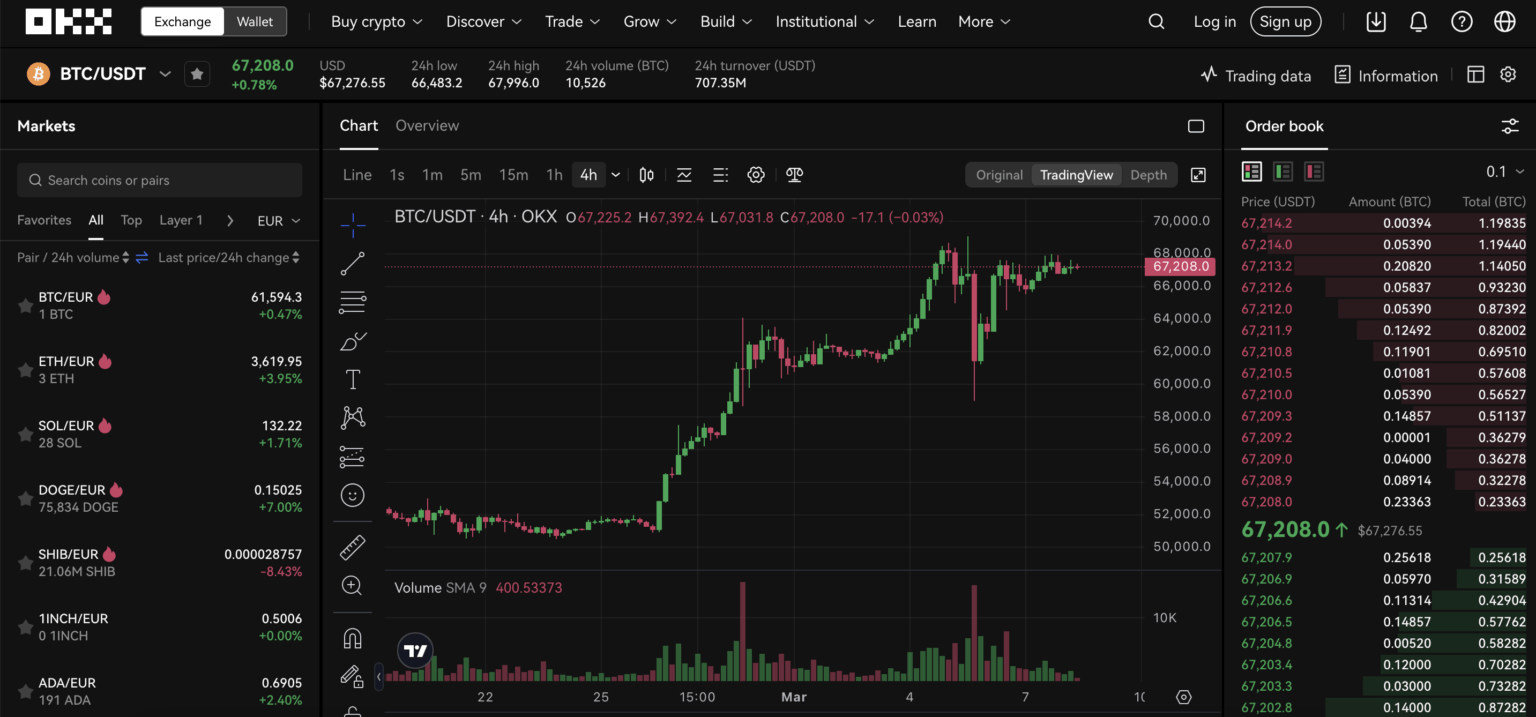
How OKX’s login and access mechanisms work — the plumbing you need to know
At the technical level, OKX implements a hybrid of centralized-account security and optional self-custodial Web3 access. For the centralized exchange (CEX) account the core controls are standard: username and password, mandatory two-factor authentication (2FA) via SMS or Google Authenticator, and optional biometric login on mobile. Behind that sits AI-driven monitoring that flags suspicious sessions and an encryption layer the company describes as “military-grade.” For a user, the relevant mechanisms are these: authentication factors (something you know, something you have, something you are), device and IP fingerprinting, and an automated challenge/lock flow when anomalies appear.
Parallel to that is OKX’s non-custodial Web3 wallet and browser extension. That wallet stores a seed phrase locally; transactions require local signing and can be paired with hardware wallets such as Ledger or Trezor. The browser extension serves as the bridge between dApps and your keys — it is both convenience and attack surface. The practical result: if you’re using the web interface plus the extension, you are combining a centrally-kept account (where OKX can help recover access) with self-custody (where the exchange cannot).
Case walk-through: logging in, verifying identity, and executing a cross-platform trade
Step through this realistic sequence. First, the trader navigates to the official login page and enters credentials. OKX’s KYC regime requires completed identity checks for full access, so an unverified or partially verified account may be rate- or feature-limited — an important constraint in a fast market. Second, 2FA is prompted: for many U.S. users that will be Google Authenticator (TOTP) or biometrics on a paired mobile device; SMS is possible but carries higher risk of SIM-swapping. Third, if the trader intends to move funds from a centralized wallet to the non-custodial Web3 wallet to use a DEX aggregator or farm yields, they must confirm a withdraw on the CEX side (subject to cold-wallet approvals) and then sign on-chain transactions via the browser extension or connected Ledger.
One useful, practical link for U.S. traders who want an organized login walkthrough is the FAQ and how-to page maintained for OKX login paths: okx login. Consult such guides but cross-check domain authenticity before entering credentials.
Where this flow breaks — concrete failure modes and their mechanics
Understanding failure modes explains why the security stack matters. Four common issues recur in practice:
1) Phishing: cloned domains and fake extension prompts can capture credentials or trick you into signing transactions. Mechanism: user inputs seed or approves a signature to a malicious contract. Limitation: 2FA may not protect against a user willingly pasting a seed into a fake site.
2) KYC frictions: if you haven’t completed identity verification, withdrawals or margin adjustments may be delayed. Mechanism: AML controls and automated limits; when the market moves fast, these delays are real operational risk. Trade-off: faster onboarding vs. regulatory compliance and counterparty risk.
3) Loss of seed phrase for the non-custodial wallet: permanent loss of access. Mechanism: single point of truth for private keys; no central recovery unless you used hardware backup. This is an absolute boundary condition — an irreversible state that many users underestimate.
4) Cold-storage withdrawal delays: OKX stores over 95% of assets in air-gapped cold wallets requiring multi-signature approvals. The security payoff is high, but the trade-off is that large withdrawals can be slower and require manual procedures.
Trading implications: execution, liquidity, and the delisting signal
From a trading perspective the login process isn’t just authentication — it’s an operational dependency that constrains what you can do during volatility. Known trading risks (high volatility, slippage, and low liquidity for certain tokens) are compounded when login or KYC steps introduce time latency. The recent, routine delisting of several small pairs by OKX is a reminder that the exchange prunes low-liquidity markets; for traders that means you should avoid carrying significant positions in thinly traded pairs you can’t liquidate quickly. When a pair is delisted, there’s typically a window to withdraw or migrate positions — but if your account access is incomplete, that window can close.
Practical takeaway: treat login readiness (completed KYC, active 2FA, accessible recovery methods) as part of your risk-management position sizing. If you regularly need to move between CEX and DeFi, pre-authorize hardware wallets and keep small balances in hot wallets for execution while the bulk of capital sits in cold storage.
Decision-useful heuristics and a simple checklist
Here is a compact framework to help you act under stress:
– Preflight: complete KYC and test a small withdrawal before markets heat up. Confirm 2FA methods work across devices. Prefer app-based TOTP or hardware keys over SMS.
– Segmentation: separate funds by function — cold storage for long-term holdings, CEX spot/margin for quick execution, and a self-custodial Web3 wallet for DeFi/NFT work. Each layer has different recovery and risk characteristics.
– Signing hygiene: never enter seed phrases into a web page. Use hardware wallets for significant on-chain approvals. Validate contract addresses before signing.
– Network and domain checks: confirm TLS certificate and exact domain; when in doubt, navigate from bookmarks or official app stores, not search results or forwarded links.
Limits, uncertainties, and what to watch next
There are several boundary conditions the reader should internalize. First, security is layered but not absolute: AI-driven login anomaly detection reduces but does not eliminate account takeover risk. Second, regulatory changes in the U.S. affecting KYC or custody could alter withdrawal rules or onboarding steps; those are policy-dependent and worth monitoring. Third, proof-of-reserves transparency provides an extra signal about solvency but does not insulate users from smart-contract risk when they move assets to DeFi protocols.
Near-term signals to monitor: changes in delisting patterns (which indicate liquidity curation), updates to wallet-extension APIs (which affect UX and attack surface), and any U.S. regulatory guidance on centralized custody. If you see increased delisting of marginal tokens, that raises the operational value of keeping positions in high-liquidity pairs when logged-in access may be intermittent.
FAQ
Q: If I lose access to my OKX account, can I recover funds?
A: If the loss concerns the centralized OKX account (forgotten password, 2FA device lost), OKX’s account-recovery process and completed KYC generally enable recovery. If the loss is of a self-custodial seed phrase for the Web3 wallet, that is permanent unless you have a secure backup or hardware wallet — custodial recovery does not apply to self-custody.
Q: Should I use SMS 2FA or an authenticator app for OKX?
A: Authenticator apps (TOTP) and hardware tokens are stronger than SMS because SMS is vulnerable to SIM-swap attacks. For U.S. users who value operational security, prefer an app-based 2FA and keep a secure, offline backup of recovery codes.
Q: How does OKX’s cold storage policy affect my ability to withdraw quickly?
A: Cold storage improves safety (multi-signature, air-gapped approvals) but can slow large withdrawals that require manual or multi-party sign-offs. For emergency execution, keep a calibrated hot balance; for long-term holdings, expect slower withdrawal cadence.
Q: Can I use OKX’s browser extension and the web interface safely together?
A: Yes, if you follow best practices: keep the extension and browser updated, use hardware wallet integration for high-value transactions, and never paste seeds into web pages. The convenience of cross-platform access adds functionality but also increases attack surface, so trade convenience for safety depending on the task.
Final practical note: logging in is not an isolated act — it is the start of a chain of operational decisions that determines whether you can act fast in a market or become a spectator. Treat readiness — verified identity, robust 2FA, tested hardware keys, and clear separation of custody roles — as part of your trading toolkit. With those practices, you reduce the odds that a login hiccup turns into a trading loss.